<?xml version="1.0" encoding="utf-8"?><feed xmlns="http://www.w3.org/2005/Atom" ><generator uri="https://jekyllrb.com/" version="3.10.0">Jekyll</generator><link href="https://wxqnl.github.io/feed.xml" rel="self" type="application/atom+xml" /><link href="https://wxqnl.github.io/" rel="alternate" type="text/html" /><updated>2026-09-09T08:48:55+00:00</updated><id>https://wxqnl.github.io/feed.xml</id><title type="html">Mingquan Liu</title><subtitle>personal description</subtitle><author><name>Mingquan Liu</name><email>wxqnl@cug.edu.cn</email></author><entry><title type="html">Future Blog Post</title><link href="https://wxqnl.github.io/posts/2012/08/blog-post-4/" rel="alternate" type="text/html" title="Future Blog Post" /><published>2199-01-01T00:00:00+00:00</published><updated>2199-01-01T00:00:00+00:00</updated><id>https://wxqnl.github.io/posts/2012/08/future-post</id><content type="html" xml:base="https://wxqnl.github.io/posts/2012/08/blog-post-4/"><![CDATA[<p>This post will show up by default. To disable scheduling of future posts, edit <code class="language-plaintext highlighter-rouge">config.yml</code> and set <code class="language-plaintext highlighter-rouge">future: false</code>.</p>]]></content><author><name>Mingquan Liu</name><email>wxqnl@cug.edu.cn</email></author><category term="cool posts" /><category term="category1" /><category term="category2" /><summary type="html"><![CDATA[This post will show up by default. To disable scheduling of future posts, edit config.yml and set future: false.]]></summary></entry><entry><title type="html">GMSWA: Constant-Cache Long-Context Memory</title><link href="https://wxqnl.github.io/posts/2026/06/gmswa-state-tracking/" rel="alternate" type="text/html" title="GMSWA: Constant-Cache Long-Context Memory" /><published>2026-06-25T00:00:00+00:00</published><updated>2026-06-25T00:00:00+00:00</updated><id>https://wxqnl.github.io/posts/2026/06/gmswa-state-tracking</id><content type="html" xml:base="https://wxqnl.github.io/posts/2026/06/gmswa-state-tracking/"><![CDATA[<p><strong>GMSWA</strong> (Gated-Memory Sliding-Window Attention) studies a practical long-context question:</p>

<blockquote>
  <p>Can a model keep the language quality of local/softmax attention, recover useful long-range recall, and avoid a growing KV cache?</p>
</blockquote>

<p>The problem is the core of the story: full attention has strong quality but its KV cache grows linearly with context; sliding-window attention keeps cache bounded but forgets beyond the window; recurrent memory is compact and recall-friendly but can trail softmax attention on base language quality. GMSWA tests whether a window-memory hybrid can keep the best parts.</p>

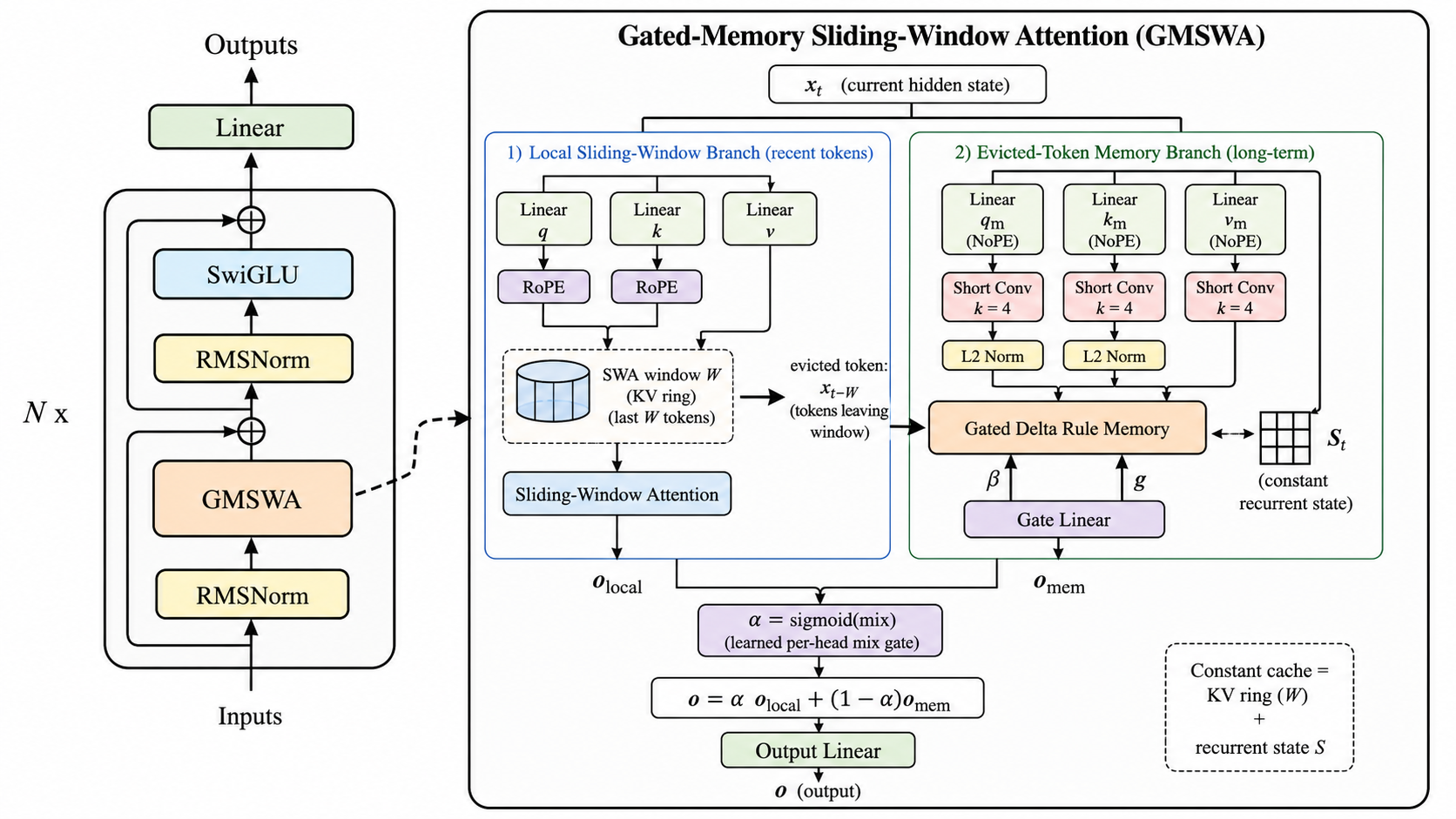
<p>The layer runs two branches: exact sliding-window attention for recent local evidence, and a gated-delta recurrent matrix memory for long-range information. A learned per-head gate mixes the two.</p>

<p><img src="/gmswa/assets/gmswa_architecture.png" alt="GMSWA architecture" /></p>

<p>The latest paper draft frames the contribution as a controlled characterization rather than an overclaim. The headline findings are:</p>

<ul>
  <li><strong>Base quality is preserved.</strong> GMSWA is on par with softmax baselines on a 10-task zero-shot suite and above a pure recurrent baseline.</li>
  <li><strong>Real semantic recall improves over local-only attention.</strong> On real recall-intensive tasks, GMSWA is comparable to the recurrent baseline: it wins on SQuAD and FDA, while trailing on SWDE.</li>
  <li><strong>The cache is constant.</strong> At 128K context, GMSWA’s KV cache is about <strong>16.3MB</strong>, versus about <strong>12.9GB</strong> for full attention — roughly <strong>790× smaller</strong> cache.</li>
  <li><strong>Synthetic needle retrieval is the limitation.</strong> On NIAH, GMSWA tracks local-window attention and trails the pure recurrent model.</li>
  <li><strong>The negative result is informative.</strong> Memory-directed controls — normalization, pathway dropout, memory-first curriculum, and memory-only training — all hurt or collapse recall, suggesting the issue is limited sharp addressing rather than simply “the model ignored memory.”</li>
</ul>

<p>Core benchmark snapshot:</p>

<table>
  <thead>
    <tr>
      <th>Model</th>
      <th style="text-align: right">Zero-shot avg ↑</th>
      <th style="text-align: right">NLL 1–2K ↓</th>
      <th style="text-align: right">NLL 2–4K ↓</th>
      <th style="text-align: right">NLL 4–8K ↓</th>
    </tr>
  </thead>
  <tbody>
    <tr>
      <td>Transformer</td>
      <td style="text-align: right"><strong>0.500</strong></td>
      <td style="text-align: right"><strong>3.62</strong></td>
      <td style="text-align: right">5.74</td>
      <td style="text-align: right">7.21</td>
    </tr>
    <tr>
      <td>SWA</td>
      <td style="text-align: right">0.498</td>
      <td style="text-align: right">3.87</td>
      <td style="text-align: right">4.14</td>
      <td style="text-align: right">4.21</td>
    </tr>
    <tr>
      <td><strong>GMSWA</strong></td>
      <td style="text-align: right"><strong>0.499</strong></td>
      <td style="text-align: right">3.78</td>
      <td style="text-align: right"><strong>4.02</strong></td>
      <td style="text-align: right"><strong>4.08</strong></td>
    </tr>
    <tr>
      <td>GDN</td>
      <td style="text-align: right">0.486</td>
      <td style="text-align: right">3.89</td>
      <td style="text-align: right">4.15</td>
      <td style="text-align: right">4.24</td>
    </tr>
  </tbody>
</table>

<p>Detailed zero-shot suite:</p>

<table>
  <thead>
    <tr>
      <th>Model</th>
      <th style="text-align: right">Avg ↑</th>
      <th style="text-align: right">LAMBADA</th>
      <th style="text-align: right">PIQA</th>
      <th style="text-align: right">HellaSwag</th>
      <th style="text-align: right">WinoGrande</th>
      <th style="text-align: right">ARC-e</th>
      <th style="text-align: right">ARC-c</th>
      <th style="text-align: right">BoolQ</th>
      <th style="text-align: right">COPA</th>
      <th style="text-align: right">OBQA</th>
      <th style="text-align: right">SciQ</th>
    </tr>
  </thead>
  <tbody>
    <tr>
      <td>Transformer</td>
      <td style="text-align: right"><strong>0.500</strong></td>
      <td style="text-align: right">0.317</td>
      <td style="text-align: right"><strong>0.660</strong></td>
      <td style="text-align: right">0.330</td>
      <td style="text-align: right">0.523</td>
      <td style="text-align: right">0.569</td>
      <td style="text-align: right">0.253</td>
      <td style="text-align: right"><strong>0.615</strong></td>
      <td style="text-align: right"><strong>0.700</strong></td>
      <td style="text-align: right">0.206</td>
      <td style="text-align: right">0.822</td>
    </tr>
    <tr>
      <td>SWA</td>
      <td style="text-align: right">0.498</td>
      <td style="text-align: right">0.315</td>
      <td style="text-align: right">0.658</td>
      <td style="text-align: right">0.326</td>
      <td style="text-align: right">0.510</td>
      <td style="text-align: right"><strong>0.577</strong></td>
      <td style="text-align: right">0.241</td>
      <td style="text-align: right">0.608</td>
      <td style="text-align: right"><strong>0.700</strong></td>
      <td style="text-align: right"><strong>0.240</strong></td>
      <td style="text-align: right">0.803</td>
    </tr>
    <tr>
      <td><strong>GMSWA</strong></td>
      <td style="text-align: right"><strong>0.499</strong></td>
      <td style="text-align: right"><strong>0.324</strong></td>
      <td style="text-align: right">0.655</td>
      <td style="text-align: right"><strong>0.330</strong></td>
      <td style="text-align: right"><strong>0.530</strong></td>
      <td style="text-align: right">0.566</td>
      <td style="text-align: right"><strong>0.258</strong></td>
      <td style="text-align: right">0.611</td>
      <td style="text-align: right">0.670</td>
      <td style="text-align: right">0.202</td>
      <td style="text-align: right"><strong>0.849</strong></td>
    </tr>
    <tr>
      <td>GDN</td>
      <td style="text-align: right">0.486</td>
      <td style="text-align: right">0.291</td>
      <td style="text-align: right">0.656</td>
      <td style="text-align: right">0.324</td>
      <td style="text-align: right">0.509</td>
      <td style="text-align: right">0.561</td>
      <td style="text-align: right">0.241</td>
      <td style="text-align: right">0.588</td>
      <td style="text-align: right">0.650</td>
      <td style="text-align: right">0.218</td>
      <td style="text-align: right">0.819</td>
    </tr>
  </tbody>
</table>

<p>MMLU is not shown because it was not part of this controlled run’s completed result set; the available standard suite includes HellaSwag, PIQA, ARC, BoolQ, COPA, OpenBookQA, SciQ, WinoGrande, and LAMBADA.</p>

<table>
  <thead>
    <tr>
      <th>Model</th>
      <th style="text-align: right">SWDE ↑</th>
      <th style="text-align: right">FDA ↑</th>
      <th style="text-align: right">SQuAD ↑</th>
      <th style="text-align: right">KV cache @128K</th>
    </tr>
  </thead>
  <tbody>
    <tr>
      <td>SWA</td>
      <td style="text-align: right">0.072</td>
      <td style="text-align: right">0.040</td>
      <td style="text-align: right">0.072</td>
      <td style="text-align: right">50MB</td>
    </tr>
    <tr>
      <td><strong>GMSWA</strong></td>
      <td style="text-align: right">0.088</td>
      <td style="text-align: right"><strong>0.094</strong></td>
      <td style="text-align: right"><strong>0.284</strong></td>
      <td style="text-align: right"><strong>16.3MB</strong></td>
    </tr>
    <tr>
      <td>GDN</td>
      <td style="text-align: right">0.110</td>
      <td style="text-align: right">0.026</td>
      <td style="text-align: right">0.274</td>
      <td style="text-align: right">3.4MB</td>
    </tr>
    <tr>
      <td>Transformer</td>
      <td style="text-align: right"><strong>0.438</strong></td>
      <td style="text-align: right"><strong>0.156</strong></td>
      <td style="text-align: right">0.066</td>
      <td style="text-align: right">12.9GB</td>
    </tr>
  </tbody>
</table>

<p>The short version: <strong>GMSWA is a practical constant-cache long-context model and a clean map of where window–memory hybrid recall works — and where it stops.</strong></p>

<p><a href="/gmswa/" class="btn btn--primary btn--large">View the visual project showcase →</a></p>]]></content><author><name>Mingquan Liu</name><email>wxqnl@cug.edu.cn</email></author><category term="long context" /><category term="attention" /><category term="language modeling" /><category term="recurrent memory" /><summary type="html"><![CDATA[GMSWA fuses exact sliding-window attention with a recurrent matrix memory. In a controlled 340M study, it preserves softmax-like base quality, recovers real semantic recall, and keeps a constant cache, while exposing a sharp synthetic-recall limitation.]]></summary></entry><entry><title type="html">WM3D: Native-3D World Modeling for Robot Action</title><link href="https://wxqnl.github.io/posts/2026/06/wm3d-native-3d-world-model/" rel="alternate" type="text/html" title="WM3D: Native-3D World Modeling for Robot Action" /><published>2026-06-08T00:00:00+00:00</published><updated>2026-06-08T00:00:00+00:00</updated><id>https://wxqnl.github.io/posts/2026/06/wm3d-native-3d-world-model</id><content type="html" xml:base="https://wxqnl.github.io/posts/2026/06/wm3d-native-3d-world-model/"><![CDATA[<p>Most world models predict the future in <strong>pixel or video-latent space</strong>. <strong>WM3D</strong> takes a different route: for robot manipulation, the state that matters is the <strong>3D world</strong> — depth, point geometry, camera/robot pose, task text, and the action that changes the scene.</p>

<blockquote>
  <p>Can a robot world model keep native 3D as its core state space, while still producing action-aware, high-quality RGB rollouts?</p>
</blockquote>

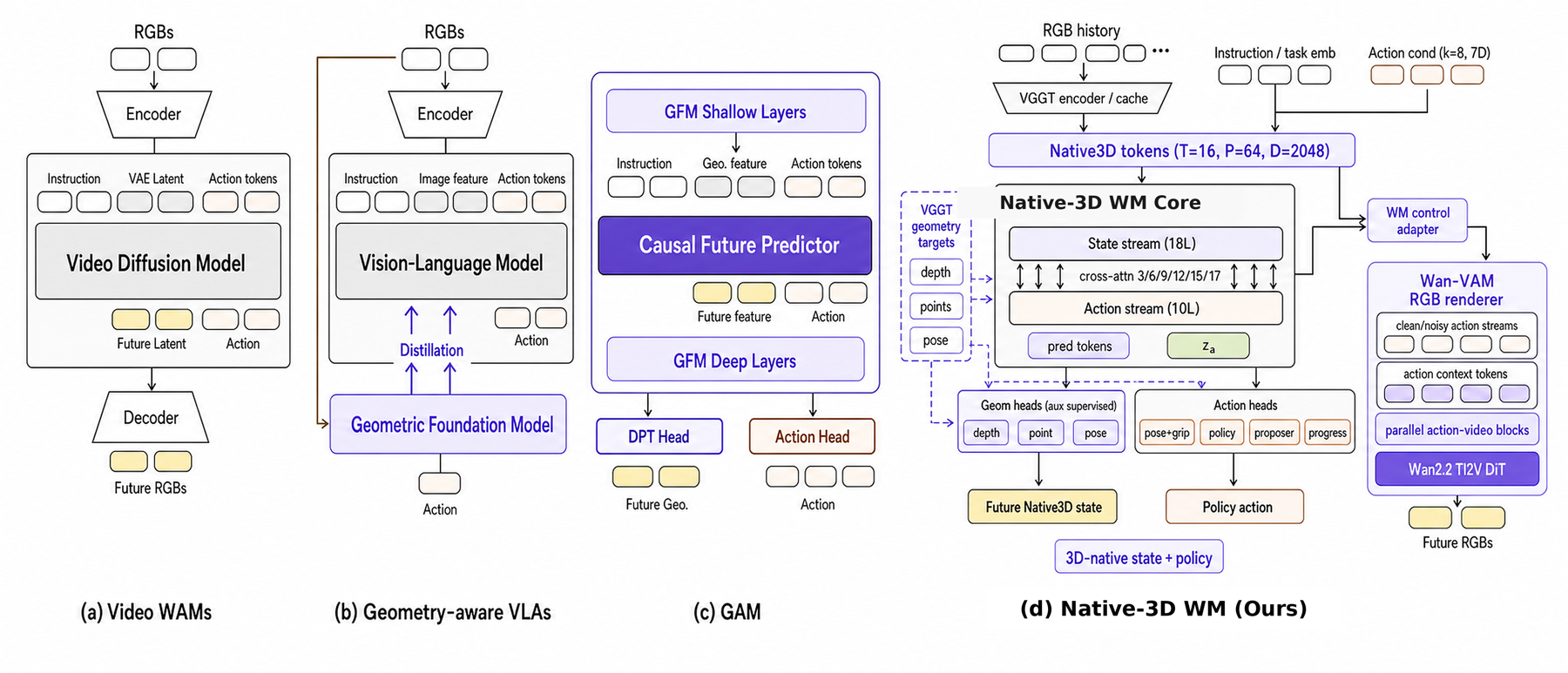
<p>That is the current WM3D story. Pixels are useful as observations and demos, but they are not the physical state a robot acts on. A plausible video can still hide the wrong depth, contact, or object motion. WM3D therefore trains action-conditioned dynamics directly over native-3D supervision, and treats RGB video as a rendered view of the imagined state.</p>

<p><img src="/wm3d/assets/native_3d_wm_architecture_comparison.png" alt="WM3D architecture comparison" /></p>

<h2 id="why-this-is-different">Why this is different</h2>

<table>
  <thead>
    <tr>
      <th>Approach</th>
      <th>Main state</th>
      <th>Strength</th>
      <th>Limitation for robotics</th>
    </tr>
  </thead>
  <tbody>
    <tr>
      <td>Video-latent world models</td>
      <td>future frames / video tokens</td>
      <td>strong visual prior and photorealism</td>
      <td>action→geometry causality is implicit</td>
    </tr>
    <tr>
      <td>Compact dynamics / policy models</td>
      <td>low-dimensional control state</td>
      <td>efficient and stable for policies</td>
      <td>can lose rich visuospatial structure</td>
    </tr>
    <tr>
      <td><strong>WM3D</strong></td>
      <td><strong>native 3D + action-conditioned dynamics</strong></td>
      <td><strong>explicit geometry, depth, pose, progress, and policy interfaces</strong></td>
      <td>RGB must be rendered without taking over the state</td>
    </tr>
  </tbody>
</table>

<p>The latest architecture makes this boundary explicit. WM3D owns the world state and action reasoning. A stronger action-aware video branch renders RGB, but the native-3D core remains central: depth, point/geometry, pose, action, proposer, progress, and policy objectives are still trained as first-class targets.</p>

<h2 id="benchmark-snapshot">Benchmark snapshot</h2>

<p>Open-loop future prediction on a balanced OXE/DROID protocol shows WM3D beating a last-frame baseline across the main RGB metrics:</p>

<table>
  <thead>
    <tr>
      <th>Metric</th>
      <th style="text-align: right">WM3D</th>
      <th style="text-align: right">Last-frame</th>
      <th style="text-align: right">Delta</th>
    </tr>
  </thead>
  <tbody>
    <tr>
      <td>PSNR ↑</td>
      <td style="text-align: right"><strong>28.374</strong></td>
      <td style="text-align: right">23.285</td>
      <td style="text-align: right"><strong>+21.9%</strong></td>
    </tr>
    <tr>
      <td>SSIM ↑</td>
      <td style="text-align: right"><strong>0.9135</strong></td>
      <td style="text-align: right">0.8744</td>
      <td style="text-align: right"><strong>+4.5%</strong></td>
    </tr>
    <tr>
      <td>LPIPS ↓</td>
      <td style="text-align: right"><strong>0.0985</strong></td>
      <td style="text-align: right">0.1199</td>
      <td style="text-align: right"><strong>−17.9%</strong></td>
    </tr>
    <tr>
      <td>RGB L1 ↓</td>
      <td style="text-align: right"><strong>0.0199</strong></td>
      <td style="text-align: right">0.0321</td>
      <td style="text-align: right"><strong>−38.1%</strong></td>
    </tr>
    <tr>
      <td>Motion RGB L1 ↓</td>
      <td style="text-align: right"><strong>0.0648</strong></td>
      <td style="text-align: right">0.1409</td>
      <td style="text-align: right"><strong>−54.0%</strong></td>
    </tr>
    <tr>
      <td>R3D18-FVD ↓</td>
      <td style="text-align: right"><strong>22.037</strong></td>
      <td style="text-align: right">28.157</td>
      <td style="text-align: right">better</td>
    </tr>
  </tbody>
</table>

<p>The more important evidence is native-3D action sensitivity:</p>

<table>
  <thead>
    <tr>
      <th>Metric</th>
      <th style="text-align: right">Value</th>
      <th>Reading</th>
    </tr>
  </thead>
  <tbody>
    <tr>
      <td>Depth future L1 ↓</td>
      <td style="text-align: right"><strong>0.02659</strong></td>
      <td>future depth is directly supervised</td>
    </tr>
    <tr>
      <td>Depth-change cosine ↑</td>
      <td style="text-align: right"><strong>0.6735</strong></td>
      <td>captures how geometry changes</td>
    </tr>
    <tr>
      <td>Depth-change sign accuracy ↑</td>
      <td style="text-align: right"><strong>0.8193</strong></td>
      <td>predicts the direction of depth change</td>
    </tr>
    <tr>
      <td>Real-action token win-rate ↑</td>
      <td style="text-align: right"><strong>0.8650</strong></td>
      <td>real actions beat counterfactual alternatives</td>
    </tr>
    <tr>
      <td>Real-action depth win-rate ↑</td>
      <td style="text-align: right"><strong>0.7825</strong></td>
      <td>action affects geometry, not just texture</td>
    </tr>
    <tr>
      <td>Motion-region depth win-rate ↑</td>
      <td style="text-align: right"><strong>0.7708</strong></td>
      <td>the effect remains in moving regions</td>
    </tr>
  </tbody>
</table>

<p>For downstream policy evaluation, the current best LIBERO spatial policy chain reaches <strong>384/500 = 76.8%</strong> over 500 episodes. I keep this separate from reconstruction metrics because lower offline loss did not always produce higher rollout success.</p>

<h2 id="current-takeaway">Current takeaway</h2>

<p>WM3D is not just a video demo. It is a state-space bet:</p>

<ul>
  <li><strong>Predict the future in native 3D.</strong></li>
  <li><strong>Treat actions as interventions on geometry.</strong></li>
  <li><strong>Render RGB as a view of the imagined world, not as the world state itself.</strong></li>
  <li><strong>Use the same state for prediction, counterfactual testing, progress scoring, action proposal, and policy evaluation.</strong></li>
</ul>

<p><a href="/wm3d/" class="btn btn--primary btn--large">View the visual project showcase →</a></p>]]></content><author><name>Mingquan Liu</name><email>wxqnl@cug.edu.cn</email></author><category term="world model" /><category term="embodied AI" /><category term="3D" /><category term="robot manipulation" /><summary type="html"><![CDATA[WM3D argues that robot world models should predict explicit 3D state — depth, point geometry, pose, robot state, task text, and action-conditioned dynamics — then render video as a view of that imagined world.]]></summary></entry><entry><title type="html">Blog Post number 4</title><link href="https://wxqnl.github.io/posts/2012/08/blog-post-4/" rel="alternate" type="text/html" title="Blog Post number 4" /><published>2015-08-14T00:00:00+00:00</published><updated>2015-08-14T00:00:00+00:00</updated><id>https://wxqnl.github.io/posts/2012/08/blog-post-4</id><content type="html" xml:base="https://wxqnl.github.io/posts/2012/08/blog-post-4/"><![CDATA[<p>This is a sample blog post. Lorem ipsum I can’t remember the rest of lorem ipsum and don’t have an internet connection right now. Testing testing testing this blog post. Blog posts are cool.</p>

<h1 id="headings-are-cool">Headings are cool</h1>

<h1 id="you-can-have-many-headings">You can have many headings</h1>

<h2 id="arent-headings-cool">Aren’t headings cool?</h2>]]></content><author><name>Mingquan Liu</name><email>wxqnl@cug.edu.cn</email></author><category term="cool posts" /><category term="category1" /><category term="category2" /><summary type="html"><![CDATA[This is a sample blog post. Lorem ipsum I can’t remember the rest of lorem ipsum and don’t have an internet connection right now. Testing testing testing this blog post. Blog posts are cool.]]></summary></entry><entry><title type="html">Blog Post number 3</title><link href="https://wxqnl.github.io/posts/2014/08/blog-post-3/" rel="alternate" type="text/html" title="Blog Post number 3" /><published>2014-08-14T00:00:00+00:00</published><updated>2014-08-14T00:00:00+00:00</updated><id>https://wxqnl.github.io/posts/2014/08/blog-post-3</id><content type="html" xml:base="https://wxqnl.github.io/posts/2014/08/blog-post-3/"><![CDATA[<p>This is a sample blog post. Lorem ipsum I can’t remember the rest of lorem ipsum and don’t have an internet connection right now. Testing testing testing this blog post. Blog posts are cool.</p>

<h1 id="headings-are-cool">Headings are cool</h1>

<h1 id="you-can-have-many-headings">You can have many headings</h1>

<h2 id="arent-headings-cool">Aren’t headings cool?</h2>]]></content><author><name>Mingquan Liu</name><email>wxqnl@cug.edu.cn</email></author><category term="cool posts" /><category term="category1" /><category term="category2" /><summary type="html"><![CDATA[This is a sample blog post. Lorem ipsum I can’t remember the rest of lorem ipsum and don’t have an internet connection right now. Testing testing testing this blog post. Blog posts are cool.]]></summary></entry><entry><title type="html">Blog Post number 2</title><link href="https://wxqnl.github.io/posts/2013/08/blog-post-2/" rel="alternate" type="text/html" title="Blog Post number 2" /><published>2013-08-14T00:00:00+00:00</published><updated>2013-08-14T00:00:00+00:00</updated><id>https://wxqnl.github.io/posts/2013/08/blog-post-2</id><content type="html" xml:base="https://wxqnl.github.io/posts/2013/08/blog-post-2/"><![CDATA[<p>This is a sample blog post. Lorem ipsum I can’t remember the rest of lorem ipsum and don’t have an internet connection right now. Testing testing testing this blog post. Blog posts are cool.</p>

<h1 id="headings-are-cool">Headings are cool</h1>

<h1 id="you-can-have-many-headings">You can have many headings</h1>

<h2 id="arent-headings-cool">Aren’t headings cool?</h2>]]></content><author><name>Mingquan Liu</name><email>wxqnl@cug.edu.cn</email></author><category term="cool posts" /><category term="category1" /><category term="category2" /><summary type="html"><![CDATA[This is a sample blog post. Lorem ipsum I can’t remember the rest of lorem ipsum and don’t have an internet connection right now. Testing testing testing this blog post. Blog posts are cool.]]></summary></entry><entry><title type="html">Blog Post number 1</title><link href="https://wxqnl.github.io/posts/2012/08/blog-post-1/" rel="alternate" type="text/html" title="Blog Post number 1" /><published>2012-08-14T00:00:00+00:00</published><updated>2012-08-14T00:00:00+00:00</updated><id>https://wxqnl.github.io/posts/2012/08/blog-post-1</id><content type="html" xml:base="https://wxqnl.github.io/posts/2012/08/blog-post-1/"><![CDATA[<p>This is a sample blog post. Lorem ipsum I can’t remember the rest of lorem ipsum and don’t have an internet connection right now. Testing testing testing this blog post. Blog posts are cool.</p>

<h1 id="headings-are-cool">Headings are cool</h1>

<h1 id="you-can-have-many-headings">You can have many headings</h1>

<h2 id="arent-headings-cool">Aren’t headings cool?</h2>]]></content><author><name>Mingquan Liu</name><email>wxqnl@cug.edu.cn</email></author><category term="cool posts" /><category term="category1" /><category term="category2" /><summary type="html"><![CDATA[This is a sample blog post. Lorem ipsum I can’t remember the rest of lorem ipsum and don’t have an internet connection right now. Testing testing testing this blog post. Blog posts are cool.]]></summary></entry></feed>