
GMSWA: Constant-Cache Long-Context Memory
Published:
GMSWA (Gated-Memory Sliding-Window Attention) studies a practical long-context question:
Can a model keep the language quality of local/softmax attention, recover useful long-range recall, and avoid a growing KV cache?
The problem is the core of the story: full attention has strong quality but its KV cache grows linearly with context; sliding-window attention keeps cache bounded but forgets beyond the window; recurrent memory is compact and recall-friendly but can trail softmax attention on base language quality. GMSWA tests whether a window-memory hybrid can keep the best parts.
The layer runs two branches: exact sliding-window attention for recent local evidence, and a gated-delta recurrent matrix memory for long-range information. A learned per-head gate mixes the two.
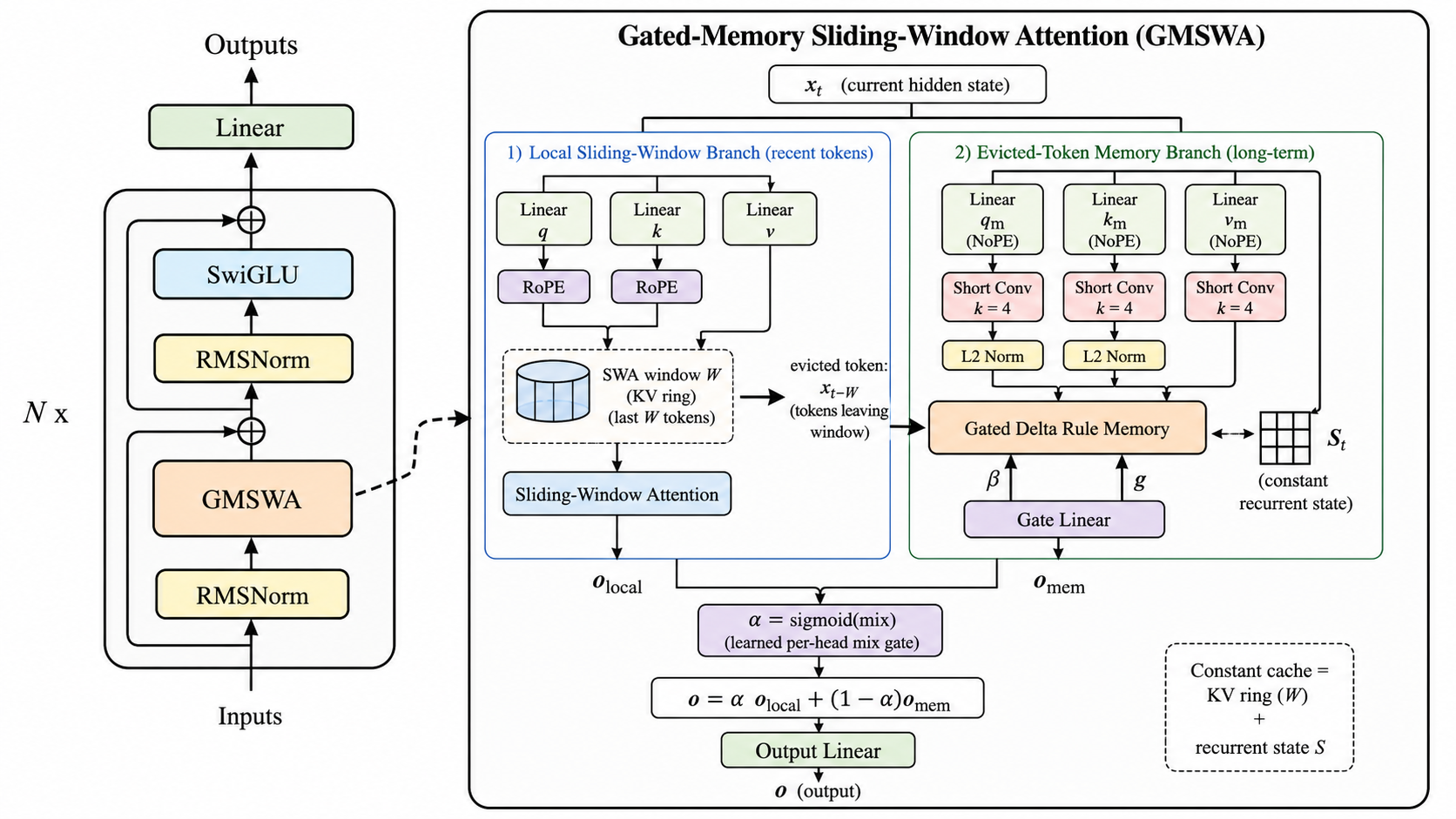
The latest paper draft frames the contribution as a controlled characterization rather than an overclaim. The headline findings are:
- Base quality is preserved. GMSWA is on par with softmax baselines on a 10-task zero-shot suite and above a pure recurrent baseline.
- Real semantic recall improves over local-only attention. On real recall-intensive tasks, GMSWA is comparable to the recurrent baseline: it wins on SQuAD and FDA, while trailing on SWDE.
- The cache is constant. At 128K context, GMSWA’s KV cache is about 16.3MB, versus about 12.9GB for full attention — roughly 790× smaller cache.
- Synthetic needle retrieval is the limitation. On NIAH, GMSWA tracks local-window attention and trails the pure recurrent model.
- The negative result is informative. Memory-directed controls — normalization, pathway dropout, memory-first curriculum, and memory-only training — all hurt or collapse recall, suggesting the issue is limited sharp addressing rather than simply “the model ignored memory.”
Core benchmark snapshot:
| Model | Zero-shot avg ↑ | NLL 1–2K ↓ | NLL 2–4K ↓ | NLL 4–8K ↓ |
|---|---|---|---|---|
| Transformer | 0.500 | 3.62 | 5.74 | 7.21 |
| SWA | 0.498 | 3.87 | 4.14 | 4.21 |
| GMSWA | 0.499 | 3.78 | 4.02 | 4.08 |
| GDN | 0.486 | 3.89 | 4.15 | 4.24 |
Detailed zero-shot suite:
| Model | Avg ↑ | LAMBADA | PIQA | HellaSwag | WinoGrande | ARC-e | ARC-c | BoolQ | COPA | OBQA | SciQ |
|---|---|---|---|---|---|---|---|---|---|---|---|
| Transformer | 0.500 | 0.317 | 0.660 | 0.330 | 0.523 | 0.569 | 0.253 | 0.615 | 0.700 | 0.206 | 0.822 |
| SWA | 0.498 | 0.315 | 0.658 | 0.326 | 0.510 | 0.577 | 0.241 | 0.608 | 0.700 | 0.240 | 0.803 |
| GMSWA | 0.499 | 0.324 | 0.655 | 0.330 | 0.530 | 0.566 | 0.258 | 0.611 | 0.670 | 0.202 | 0.849 |
| GDN | 0.486 | 0.291 | 0.656 | 0.324 | 0.509 | 0.561 | 0.241 | 0.588 | 0.650 | 0.218 | 0.819 |
MMLU is not shown because it was not part of this controlled run’s completed result set; the available standard suite includes HellaSwag, PIQA, ARC, BoolQ, COPA, OpenBookQA, SciQ, WinoGrande, and LAMBADA.
| Model | SWDE ↑ | FDA ↑ | SQuAD ↑ | KV cache @128K |
|---|---|---|---|---|
| SWA | 0.072 | 0.040 | 0.072 | 50MB |
| GMSWA | 0.088 | 0.094 | 0.284 | 16.3MB |
| GDN | 0.110 | 0.026 | 0.274 | 3.4MB |
| Transformer | 0.438 | 0.156 | 0.066 | 12.9GB |
The short version: GMSWA is a practical constant-cache long-context model and a clean map of where window–memory hybrid recall works — and where it stops.