
WM3D: Native-3D World Modeling for Robot Action
Published:
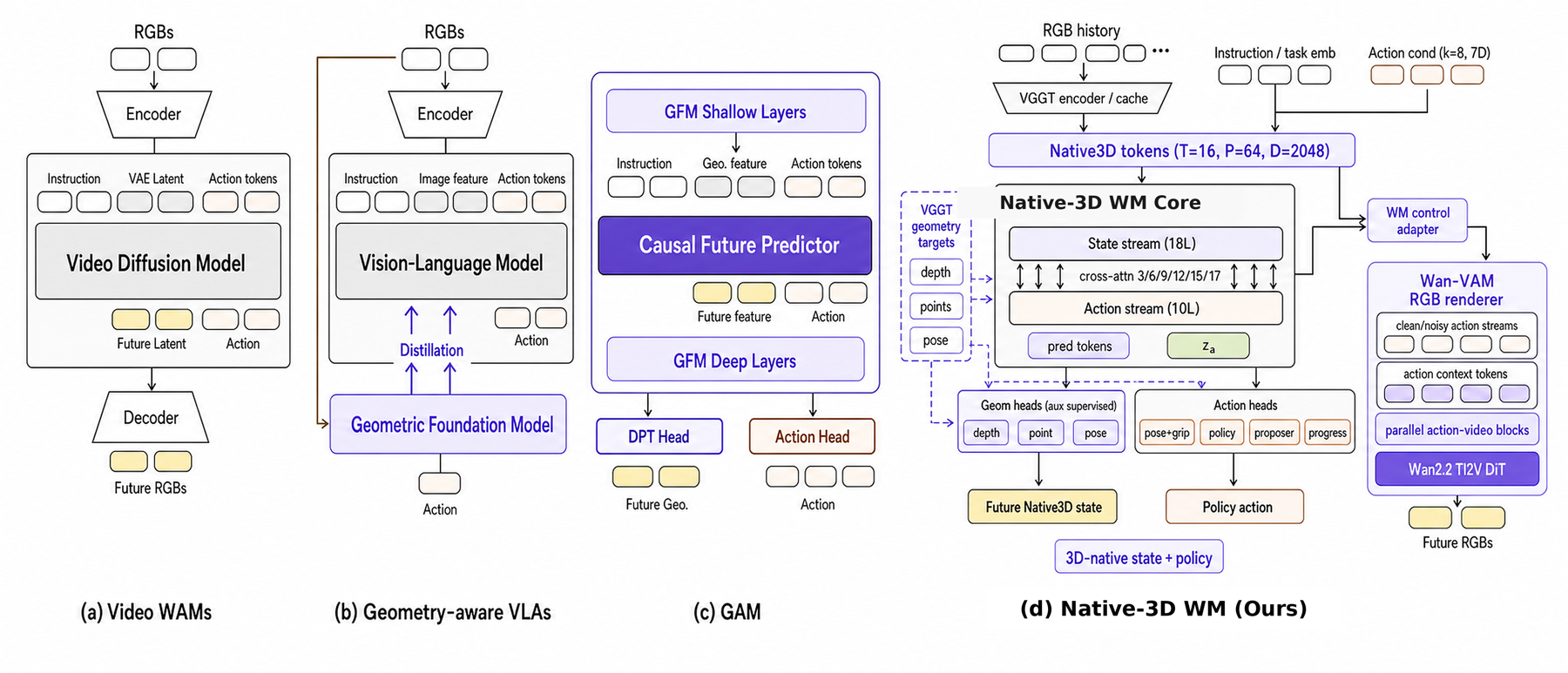
Most world models predict the future in pixel or video-latent space. WM3D takes a different route: for robot manipulation, the state that matters is the 3D world — depth, point geometry, camera/robot pose, task text, and the action that changes the scene.
Can a robot world model keep native 3D as its core state space, while still producing action-aware, high-quality RGB rollouts?
That is the current WM3D story. Pixels are useful as observations and demos, but they are not the physical state a robot acts on. A plausible video can still hide the wrong depth, contact, or object motion. WM3D therefore trains action-conditioned dynamics directly over native-3D supervision, and treats RGB video as a rendered view of the imagined state.
Why this is different
| Approach | Main state | Strength | Limitation for robotics |
|---|---|---|---|
| Video-latent world models | future frames / video tokens | strong visual prior and photorealism | action→geometry causality is implicit |
| Compact dynamics / policy models | low-dimensional control state | efficient and stable for policies | can lose rich visuospatial structure |
| WM3D | native 3D + action-conditioned dynamics | explicit geometry, depth, pose, progress, and policy interfaces | RGB must be rendered without taking over the state |
The latest architecture makes this boundary explicit. WM3D owns the world state and action reasoning. A stronger action-aware video branch renders RGB, but the native-3D core remains central: depth, point/geometry, pose, action, proposer, progress, and policy objectives are still trained as first-class targets.
Benchmark snapshot
Open-loop future prediction on a balanced OXE/DROID protocol shows WM3D beating a last-frame baseline across the main RGB metrics:
| Metric | WM3D | Last-frame | Delta |
|---|---|---|---|
| PSNR ↑ | 28.374 | 23.285 | +21.9% |
| SSIM ↑ | 0.9135 | 0.8744 | +4.5% |
| LPIPS ↓ | 0.0985 | 0.1199 | −17.9% |
| RGB L1 ↓ | 0.0199 | 0.0321 | −38.1% |
| Motion RGB L1 ↓ | 0.0648 | 0.1409 | −54.0% |
| R3D18-FVD ↓ | 22.037 | 28.157 | better |
The more important evidence is native-3D action sensitivity:
| Metric | Value | Reading |
|---|---|---|
| Depth future L1 ↓ | 0.02659 | future depth is directly supervised |
| Depth-change cosine ↑ | 0.6735 | captures how geometry changes |
| Depth-change sign accuracy ↑ | 0.8193 | predicts the direction of depth change |
| Real-action token win-rate ↑ | 0.8650 | real actions beat counterfactual alternatives |
| Real-action depth win-rate ↑ | 0.7825 | action affects geometry, not just texture |
| Motion-region depth win-rate ↑ | 0.7708 | the effect remains in moving regions |
For downstream policy evaluation, the current best LIBERO spatial policy chain reaches 384/500 = 76.8% over 500 episodes. I keep this separate from reconstruction metrics because lower offline loss did not always produce higher rollout success.
Current takeaway
WM3D is not just a video demo. It is a state-space bet:
- Predict the future in native 3D.
- Treat actions as interventions on geometry.
- Render RGB as a view of the imagined world, not as the world state itself.
- Use the same state for prediction, counterfactual testing, progress scoring, action proposal, and policy evaluation.